
Go control a real robot. Right now. For free.
Meta’s AI bill, Azure at $100B, robot ban, free ChatGPT, Fed holds.
Hi 👋,
Welcome to another edition of Why Join.
Every company reports the same three numbers, and only one of them is hard to bend. Revenue is a story about demand. Earnings are a story about accounting. Cash is what’s left after both stories are told.
That’s why the cash flow statement is the most honest document a company produces. It shows you what management actually believes, not what they said on the call. A company that talks about a decade-long bet and spends nothing is bluffing. A company that talks about discipline and burns everything is telling you the truth by accident.
The uncomfortable part is that conviction and panic look identical on paper. Both show up as a number going down. You can’t tell them apart in the quarter. You can only tell them apart in five years, which is exactly when nobody is checking anymore.
So the market prices the story instead. It has to. Nobody has the other data yet.
Spending is a claim about the future that costs something to make. Everything else is a press release.
On to who raised, who's hiring, and what we're reading.
In partnership with: THNKS

You didn’t automate your relationships. So why did you automate every message in them?
Every email, sequence, and follow up now asks your customer for something. The one touch that asks for nothing is the one they remember. Send a coffee, lunch, or ride from the tools you already use. No form, no reply, no meeting. Small gestures. Big results.
Who Recently Raised 💰
🇮🇱 Enigma

💵 Raised: $71M seed, led by Index Ventures and Ribbit Capital. Sarah Guo’s Conviction also in, plus leaders from OpenAI, Anthropic, DeepMind, xAI, Cognition, and Wiz.
One-liner: AI models and interfaces to make controlling any robot feel effortless, starting by putting 100 robots online for anyone to use.
Why it’s a fave ツ: Most robotics companies are racing on capability. Can the robot fold the shirt, can it do the dexterous thing it wasn’t trained on. Enigma is chasing a different problem: even with the most capable models today, telling a robot what you want is miserable. If you had to spend 15 minutes explaining to a robot where every dish goes, you’d give up and do it yourself. Everyone’s at that point right now. Capability isn’t the only wall. Interface is.
Think of a car volume knob. You turn it, instantly hear whether it’s too loud, and adjust. Now imagine having to set the volume as an exact percentage without hearing the result. That’s roughly what controlling a robot feels like today. Enigma wants to find the robotics equivalent of that knob, the interaction so intuitive nobody has to think about it.
To find it, they’ve been running an unusual experiment. Anyone in the world can visit robots.online and control one of more than 100 real AI robots in real time. The robots are housed in hangars in Israel and California, where they can draw with a paintbrush, sword-fight each other, and run simple chemistry experiments with flasks. Every interaction teaches Enigma how people instinctively try to communicate with a machine (text, voice, showing a video, tap and drag) and that data feeds back into both the interface and the underlying model. They built the robotic arms and the models from scratch, and the models are hardware-agnostic, meaning they can adapt to a new machine with a fraction of the training data usually required.
🇺🇸 Fish Audio
💵 Raised: $52M seed, led by Coreline Ventures and Capital Today. 359 Capital, HF0, and others also in.
One-liner: Voice AI with word-level emotion control.
Why it’s a fave ツ: Most synthetic voices are flat. Fine for a menu prompt, useless when you need a game character to sound scared or an avatar to sound genuinely warm. The technical gap Fish Audio went after is control. Their S2 model lets you drop instructions inline at the word level using free-form tags like [whisper] or [professional broadcast tone]. Not a fixed menu, open-ended description. They count 15,000+ of these controls. The model is 4 billion parameters, trained on 10 million+ hours of audio across roughly 80 languages, and can clone a voice from a 5-second clip in about 15 seconds. On independent-style benchmarks like EmergentTTS-Eval and Seed-TTS Eval, S2 scores at or above closed models from Google and OpenAI, which is a real achievement for a small team.
The consent problem is real. Fish Audio built part of its voice library by letting users upload voices and earn money when those voices were used. But a UK voice actor found her voice had been cloned and downloaded more than 900 times on Fish Audio without permission. The company now says verified takedowns happen within three minutes, but only after the artist discovers the upload and files a claim. That is the core tension: Fish Audio’s open model drove growth, but it only works long-term if consent, attribution, and revenue-sharing are built in from the start.
🇺🇸 Andrenam

💵 Raised: $18M Series A, led by Upfront Ventures. Valor Equity Partners, Also Capital, and First Round Capital also in. $30M total. The $10M seed last year closed in 36 hours.
One-liner: Distributed network of underwater acoustic sensors, plus AI software to make sense of what they hear.
Why it’s a fave ツ: The ocean is enormous and almost impossible to watch. We track planes across the sky in real time, but underwater is a near-total blind spot, especially the sneaky stuff happening below the surface. The reason is physics. Radar and cameras don’t work through water. Sonar is the only thing that reaches long range, and building sonar coverage across an ocean is a genuinely hard problem nobody has solved at scale.
Andrenam builds two things. Pearl is a networked buoy with a suspended passive sonar array that listens for the bumps, whirs, and rumbles of vessels moving underwater. They’ve built 35 of them, logging over 4,500 in-water hours off the California and Washington coasts. All that sensor data feeds in real time to Obsidian, their software, which detects, tracks, classifies, and estimates the probability of what type of vessel it’s hearing, then plugs into whatever command systems the end user already runs.
Why this matters now: China is building submarines at roughly six times the annual rate of the US, and criminal organizations are increasingly moving product underwater. There’s a real intelligence gap in wide-area underwater sensing, and there are a lot of unmanned systems in the water now that need something to actually listen for them.
Hiring: Head of Finance, Senior Software Engineer, Federal Account Executive, Supply Chain Manager - Torrance
🇺🇸 Paper

💵 Raised: $34M Series A, co-led by Accel and ICONIQ. Designer Fund, Michael Grinich (WorkOS), Anton Osika (Lovable), and engineers from Anthropic and OpenAI also in.
One-liner: Design tool where everything on the canvas is real HTML and CSS, built for a world where agents write the code.
Why it’s a fave ツ: Every design tool ever made has the same gap. You design in one format (Figma’s proprietary canvas), then someone translates it into code. That handoff is where things break, timelines slip, and the final product drifts from the design. It was an annoying but tolerable problem when humans did all the coding. Now that coding agents like Claude Code and Codex write more and more of the actual software, the translation step becomes a real bottleneck, because the agent works in code and the designer works in a format the agent can’t natively touch.
Paper removes the translation step entirely. Every element you place on the canvas is actual HTML and CSS. What you design is what ships. No export, no conversion, no handoff gap. And their MCP server exposes 24 bidirectional tools, which is the part that matters for agentic workflows. Figma’s MCP server gives an agent a window into your design (read-only, it can look but not touch). Paper’s gives the agent a steering wheel. An agent can read the design and modify the canvas directly, sync tokens, pull in live API data, convert a design to React and commit it to GitHub. A third-party benchmark found Paper used roughly 6K tokens and 3 minutes per AI design task versus Figma’s 20K tokens and 10 minutes.
The timing is hard to ignore. Figma’s stock is down 40% in 2026, partly on fears that agentic design tools could weaken the proprietary-canvas model it spent a decade building. Paper is a working example of that threat. But Figma still has roughly 90% market share, deep enterprise adoption, strong network effects, and high switching costs. Paper barely appears in industry usage data, and design tools depend heavily on collaboration and ecosystem, where Figma has a decade-long lead. Paper is growing, but from a small base. The real question is whether a code-native canvas can shift the market faster than Figma can adapt.
Open Tabs (stuff we’re reading) 📖
OpenAI giving 100K academics free ChatGPT access through 2027: Researchers in biology, chemistry, CS, engineering, math, physics get access to OpenAI’s most advanced models including GPT-5.6 Sol Pro. Roughly equivalent to the $200/mo Pro tier. Each researcher can invite four collaborators. Data won’t be used for training. First 10K getting access this summer. Part of $250M+ commitment to external scientific research through 2027. The catch: program covers math and sciences but not AI research itself. And researchers still don’t get model weights or training data, which is what AI researchers actually want for independent safety evaluations. Tools yes, transparency no.
Fed holds rates at 3.5-3.75%: 9-3 vote. Fifth straight hold. Chairman Warsh: "There is no soft inflation target. Not on this committee's watch." Fed's preferred inflation gauge at 3.4% through May. The fractured vote suggests holding is getting harder. Uncertainty from tariffs, the Iran conflict, and AI-driven demand all adding to inflation fears.
Meta misses, free cash flow nearly gone: Q2 revenue $60.8B (beat slightly), but EPS missed: $6.18 vs $7.22 expected. Q3 revenue guidance $61-64B, below the $63.15B Street estimate. The real number: free cash flow collapsed to $784M from $8.55B a year ago. AI spending is the reason. Capex guidance narrowed to $130-145B for the year. Total costs up 55% YoY, includes $2.4B in legal charges and $1.18B in severance from the May layoffs. Net income fell to $15.85B from $18.34B. Reality Labs lost $4.6B on $431M revenue.
Microsoft beats, Azure crosses $100B: Azure grew 43% in fiscal Q4, fastest in four years. Annual Azure revenue topped $100B for the first time. Total quarterly revenue $90B (up 18%), net income $35.8B (up 31%). Full year revenue $331.8B. Intelligent Cloud segment: $39.3B (up 32%). Copilot hit 30M paid users, up from 20M last quarter. $3.2B gain from Anthropic investment baked in. More Personal Computing segment declined 4%, Xbox content and services revenue down 10%, Windows OEM down 7%. Still free-cash-flow positive.
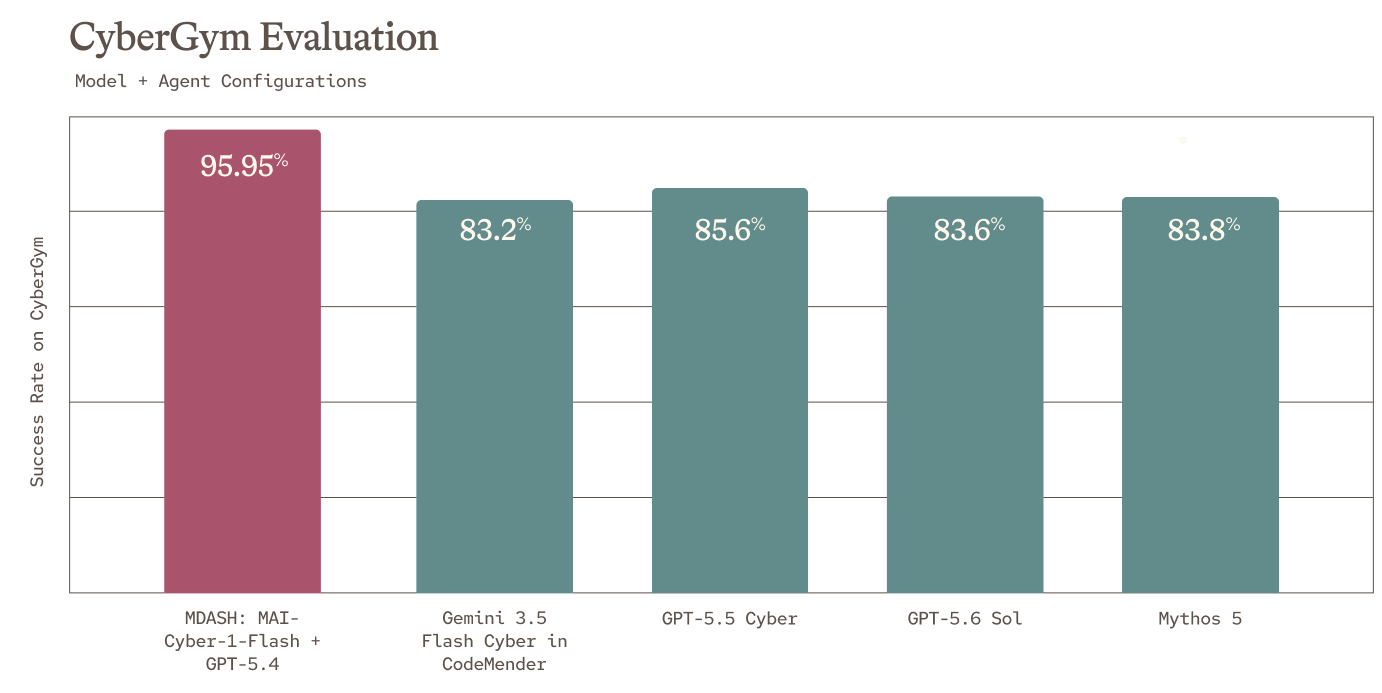
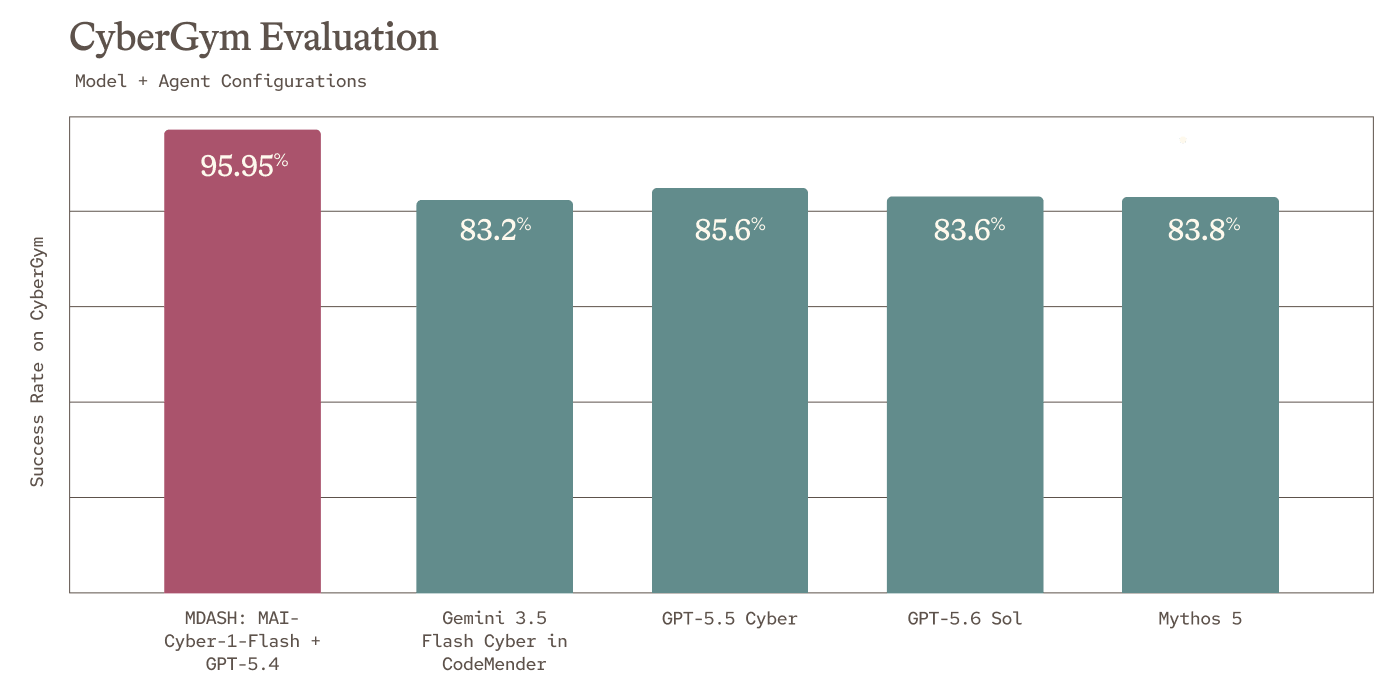
Microsoft launches first cybersecurity AI model: MAI-Cyber-1-Flash, built to find vulnerabilities in complex codebases. Scores 96% on CyberGym, beating Anthropic’s Mythos 5, GPT-5.5 Cyber, and GPT-5.6 Sol. Combined with GPT-5.4 inside the MDASH harness, handles 90% of tasks cheaply and routes the hard 10% to the bigger model. 50% cost savings. Also launching Perception, an agentic security platform with AI red/blue/green teams that can discover, prioritize, and fix vulnerabilities in minutes instead of hours. Directly competing with Anthropic’s Mythos/Glasswing and OpenAI’s Daybreak program.
Trump admin bans new Chinese humanoid robots and power inverters: FCC barred imports of new Chinese humanoid robots, quadruped robots, and connected power inverters. China dominates humanoids with ~85% global market share. Of the ~15,000 humanoid robots shipped globally in 2025, Chinese companies Unitree and AGIBOT each shipped 5,000+. Tesla and Figure AI each shipped a few hundred or less. Unitree (~20% market share) was recently added to the Pentagon’s Chinese military-backed companies list despite having a Nvidia partnership using Blackwell chips. Inverter ban hits Sungrow and Huawei. The fear: robots could spy and send data to Beijing, inverters could be compromised like the Volt Typhoon router hack.
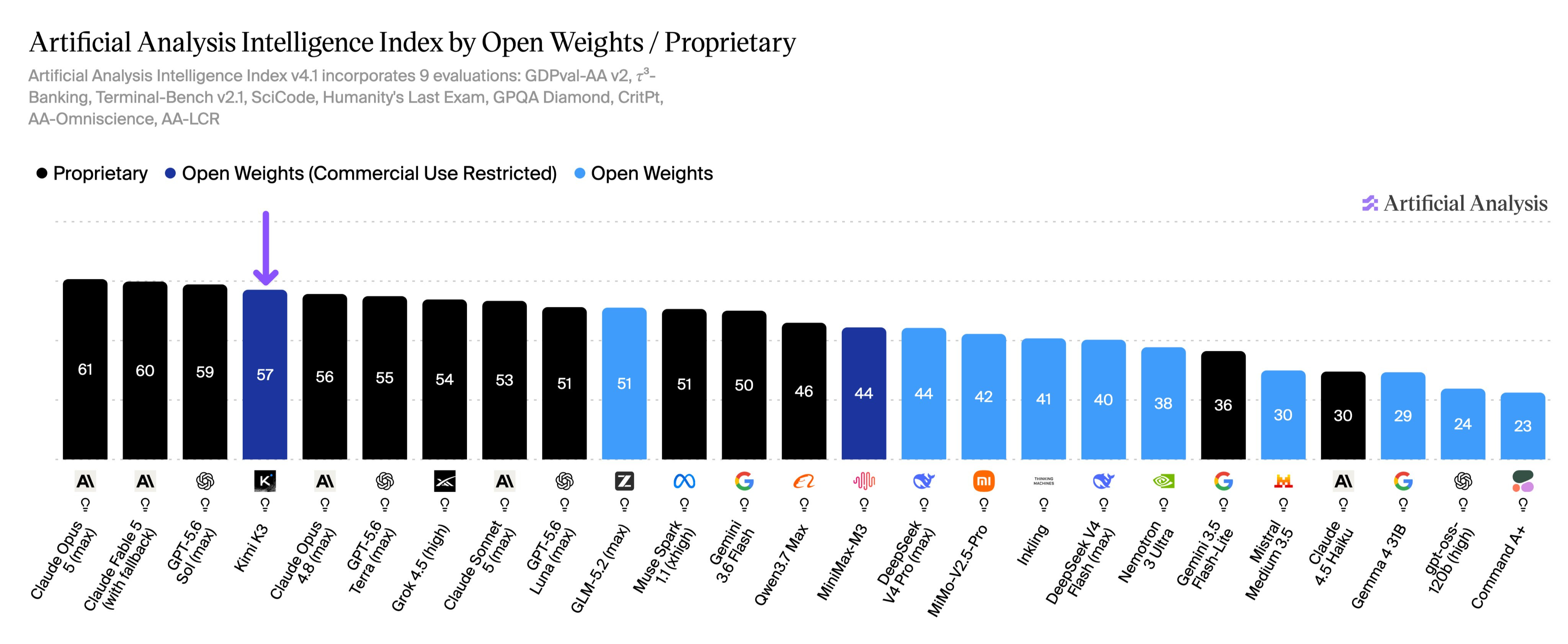
Moonshot open-sources Kimi K3, but with a catch: The Chinese AI startup released its model’s technical details publicly, but large-scale users will need commercial licenses. First Chinese AI company to make that requirement explicit. K3 shook Silicon Valley when it dropped earlier this month, matching top OpenAI and Anthropic models on some tasks. The model is too large to run on a basic computer, so most users will either subscribe through Moonshot or go through a licensed third party. Two days after announcing K3, Moonshot had to stop accepting new users because it couldn’t get enough chips to serve them.
Apple launches device leasing program with Klarna: Called “Apple Upgrade.” Monthly installments starting at $17.99 for iPhone, $11.99 for Apple Watch, $24.99 for Mac, $11.99 for iPad. 1-2 year leases for iPhone/Watch, 2-3 year for Mac/iPad. At the end you can upgrade, buy outright, or return. Replaces Apple’s existing in-house financing programs (iPhone Upgrade Program, iPhone Payments) in the US. The context: Apple recently hiked Mac and iPad prices due to “RAMageddon,” the industry-wide memory chip shortage driving up hardware costs. This is Apple’s way of softening the sticker shock. 3% Daily Cash back if you pay with Apple Card.
PayPal leaves door open to Stripe deal, but not at $60.50: Q2 earnings beat expectations: adjusted EPS $1.38 (vs $1.28 expected), revenue $8.68B (up 5% YoY, above $8.47B estimates), adjusted FCF $1.8B. CEO Lores didn’t shut down the Stripe/Advent bid but didn’t accept either, saying PayPal would consider any path that creates “superior value.” Cantor values PayPal closer to $70/share. Stock trading at ~$58. Turnaround continues: reorg into three segments, targeting $1.5B in cost savings over 2-3 years, migrating from data centers to cloud. Lores still framing PayPal as an AI-driven tech company, not a legacy payments business.
DoorDash building its own drone delivery business: Called DoorDash Air. Just got FAA Part 135 air carrier certification. Building custom aircraft in-house through DoorDash Labs, the same team behind Dot, its autonomous sidewalk delivery bot (already operating in Phoenix suburbs and Fremont, CA). Software called Autonomous Delivery Platform decides in real-time whether to dispatch a human driver, drone, or sidewalk bot. Keeping existing partnerships with Wing and Flytrex. No timeline on when drones actually start delivering. Still needs FAA Beyond Visual Line of Sight approval to fly autonomously, which Amazon, Wing, and Zipline already have.
X Money app launches in the US: Paid X subscribers get a Visa debit card (instant Apple Pay, physical card coming), fee-free P2P transfers, no foreign transaction fees, free ATM withdrawals worldwide. Premium+ users ($40/mo) get 6% APY. Premium users ($8/mo) can get 6% too if they link direct deposit, plus early access to paychecks and up to 3% cash back. This is Musk’s 25-year-old dream coming full circle. He founded X.com as a financial services startup in 1999, it merged into PayPal, and now he’s essentially rebuilding it inside the platform he renamed X.
Who’s Hiring 💼
Techstars: Operations Associate - Los Angeles
Unusual Ventures: Operating Partner - San Francisco
Prime Intellect: Head of Marketing, Head of Growth, Full-stack Engineer - San Francisco; AI Research Resident - Open Source AGI - Remote
Venice AI: Software Engineer - Remote
Super.com: Senior Data Analyst, Full-stack Engineer, Payments Engineering Intern (12-month), Software Engineering Intern - Product (Full-stack), Legal Intern, Travel Supply Analyst Intern (8-month) - Remote
Osmo: Head of IT - New Jersey
Rivet: Account Executive, Tax Manager, SDR - Remote
Kaizen: Federal Growth Lead, Federal Proposal Writer & Capture Strategist, Head of Brand & Storytelling, Digital Designer - New York, Remote
Firefly: Visual Designer - Brand, Enterprise BDR, Founding Growth Marketer, Software Engineer - New York
Paces: Product Manager, Demand Gen Lead, Product Marketer, Software Engineer (Junior) - New York
Koah Labs: Content Marketer - New York; Founding Head of Ad Sales - San Francisco/New York; Product Designer - San Francisco/London/New York
Fresco: Sales Development Representative, Founding Software Engineer - San Francisco
Willow: Founding Growth & Content Lead, ML Engineer - San Francisco
Alta: GTM, Sales, AI Engineer - Tel Aviv/US, Remote
Monumental: BizOps/Special Projects, General Manager, Technical Recruiter, GTM, Head of People & Performance - Amsterdam/US, Remote
Spade: Finance Lead, Account Executive - New York
Monk: Full-stack, Strategy & Operations Lead, BDR - New York
Prism Data: Accounting and Finance Manager, Partnerships Manager, Sales Associate, Software Engineer - NYC/San Diego, Remote
Stuut: People Operations Manager, Director of Product Marketing, Applied AI, Full-stack, Business Development Representative (BDR) - New York
Metal: Account Executive, Forward Deployed Investor - New York
Thira: Founding AI Engineer - Seattle
Sable: Growth, Founding Account Executive, Founding Designer, Research Engineer - San Francisco
Closure: Founding Deployment Strategist, Founding AI Engineer, Business Development/Account Executive - New York/San Francisco
HealthKey: Account Executive (Founding GTM) - Austin
If you haven’t yet, please subscribe, like, leave a comment, and share it! It helps us continue to bring you the most interesting news + nuance in tech and business every week.
See you Saturday, Ryan
Sponsorships: We are now accepting sponsors for Q3/Q4 ‘26. If you are interested in reaching my audience of founders, investors, and tech executives, send me an email at chief@whyjoin.xyz.