
You Can't Edit AI
$50M for AI's control layer. Plus: Google puts $40B into Anthropic, OpenAI drops the charter that made it OpenAI, and X kills Communities because 0.4% of users generated 80% of its spam.
Hello hello!
Welcome to another edition of Why Join.
There’s a famous story about the Panama Canal. The French started it in 1881. They had the most celebrated builder on the planet, Ferdinand de Lesseps, the man who built the Suez Canal. Same playbook, bigger ambition. And for eight years they dug. Tens of thousands of workers, $287 million in 1880s dollars, and they could absolutely move earth. That was never the question. The machines worked. The dynamite worked. They could excavate with the best of them.
They just couldn’t control where the water went afterward.
Landslides refilled what they’d dug. The Chagres River flooded the cuts every rainy season. Mosquitoes killed workers by the thousands because standing water was everywhere and nobody understood drainage or disease control. The project went bankrupt in 1889. De Lesseps was convicted of fraud. He died a year later, broken.
When the Americans took over in 1904, they didn’t just show up with better shovels. They showed up with a different theory of the problem. The lock system, the Gatun Dam that tamed the Chagres instead of fighting it, a massive mosquito eradication campaign that cut the death rate by over 90%. The canal opened in 1914. The breakthrough was never the ability to move earth. It was the ability to decide what happened after the earth moved.
Every major technology goes through this exact sequence. The capability arrives first and gets all the attention. Then someone has to build the infrastructure that makes the capability actually obey you. The first part is a spectacle. The second part is a company.
On to who raised.
In partnership with

Stop drowning in research papers.
Anara is the AI workspace built for researchers, scientists, and students who need answers they can actually trust. Upload any paper, textbook, or study and get instant, cited responses pulled directly from your sources, not hallucinated from memory. Search PubMed, arXiv, and JSTOR from one place. Auto-generate citations as you write. Over 2 million researchers at Stanford, MIT, Mayo Clinic, and GSK already use it daily. Free to start, no credit card required. Backed by Y Combinator.
If you’re interested in sponsoring this newsletter, please reach out here.
🇺🇸 ComfyUI

⛀⛁ Raised: $30M at a $500M valuation, led by Craft Ventures. Pace Capital, Chemistry, and TruArrow also in.
One-liner: Node-based tool that gives creators precise control over AI-generated images, video, and audio.
Why it’s a fave ツ: If you’ve used Midjourney or DALL-E, you know the problem. You prompt something, it gets 60-80% there. Then you try to fix the remaining 20%, and the model rewrites everything, including the parts that were already good. Like a slot machine. You keep pulling the lever hoping to land on what you want, but every pull reshuffles the whole thing.
ComfyUI solves this with a node-based interface (think visual building blocks you connect together) where creators can control every individual step of the generation process. Want to change the lighting without touching the composition? Swap a texture without regenerating the whole image? You can do that. You can’t do that in a prompt box.
Started as an open-source project in 2023, right after diffusion models (the tech behind AI image generation) dropped. Back then, the models could barely draw hands correctly. The tool got so popular with creative professionals that it turned into a real company. Now has 4 million+ users. That open ecosystem is the structural advantage no closed tool can replicate.
Hiring: Partnership & Events Marketing Manager, Lifecycle Growth Marketer, BizOps Strategist, Product Manager, ComfyUI, Software Engineer, ComfyUI Desktop, Graphic Designer, Design Engineer, Creative Artist, Senior Product Designer - San Francisco; Software Engineer, Frontend - Remote/San Francisco
🇵🇱 GRAI

⛀⛁ Raised: $9M seed, co-led by Khosla Ventures and Inovo VC. a16z Scout Fund, Tensor Ventures, Tiny.VC, Flyer One Ventures also in.
One-liner: AI music platform that lets people play with tracks instead of generate them from scratch.
Why it’s a fave ツ: Every AI music startup right now (Suno, Udio) is focused on generation. Type a prompt, get a song. But most people don't actually want to create music from scratch. They want to mess around with songs they already like. Remix a track, change the style, send it to a friend. Music is one of the last major consumer categories that hasn't gone social and creator-first. Discovery is broken, listening is passive, and there’s basically zero social context around any of it.
GRAI is building apps where people can play with real tracks. Remixing, restyling, sharing. Not generating AI slop and dumping it on Spotify. And here’s where they diverge from basically every other AI music company: they’re talking to labels first. Not building and asking forgiveness later. The whole system is designed so artists opt in and opt out. If remixing takes off it creates a new royalty stream for artists and labels rather than undercutting them. Whether labels actually go for that... we’ll see. But at least they’re asking.
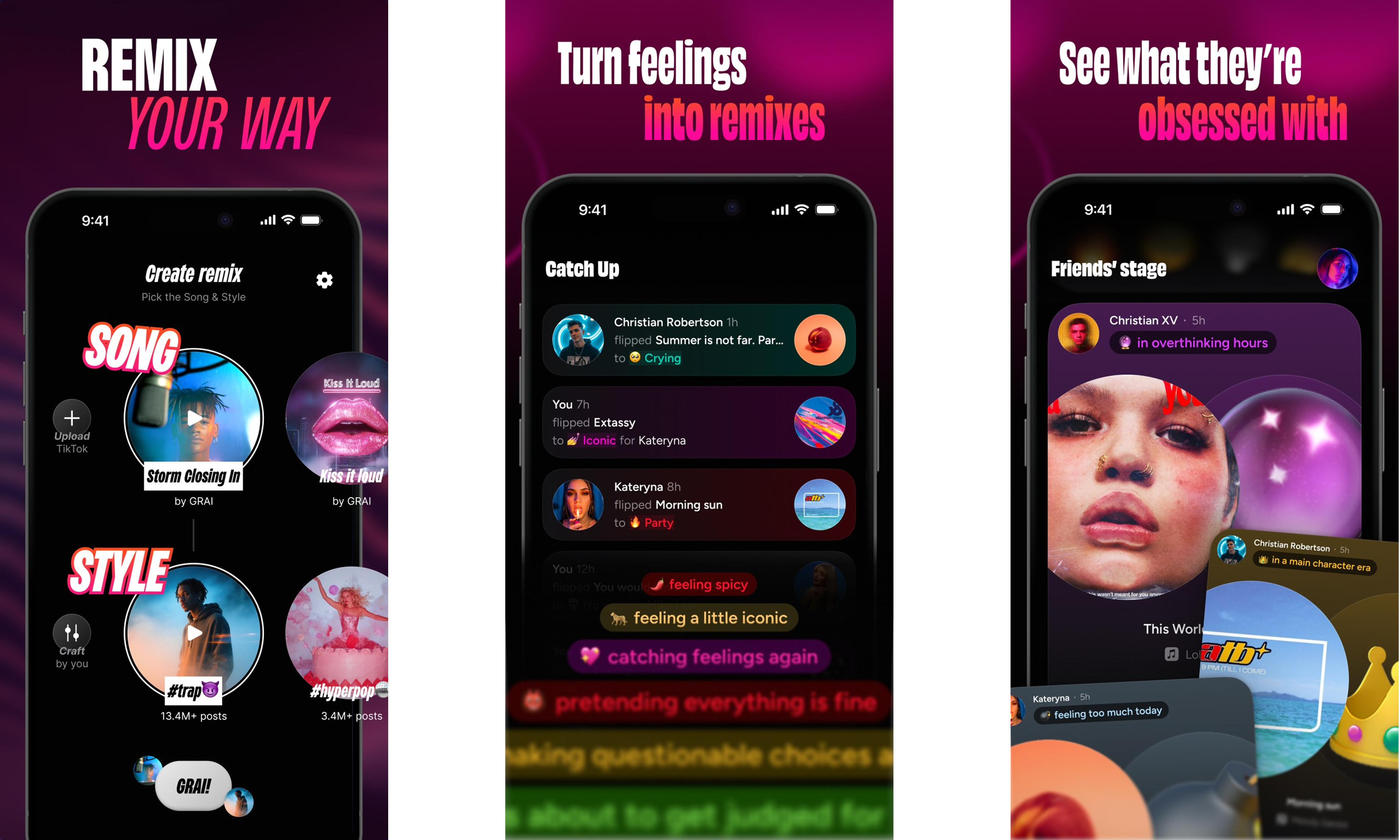
They built their own infra for this. Taste and participation graph, real-time audio systems that preserve the identity of original tracks while allowing transformation, a derivatives pipeline for modified versions. Two apps live now, one iOS (Music with friends), one Android. Going after Gen Z and Gen Alpha who discover music through friends and fandoms and short-form content, not playlist algorithms (over 80% of US recorded music revenue now comes from streaming, and on those platforms the algorithm decides what you hear).
Hiring: Android Developer, Python Engineer (MLOps/Data Infrastructure), QA Engineer, Research Engineer, Head of Finance & Operations - Warsaw
🇺🇸 Era

⛀⛁ Raised: $11M total. $9M seed led by Abstract Ventures and BoxGroup, with Collaborative Fund and Mozilla Ventures. $2M pre-seed from Topology Ventures and Betaworks.
One-liner: Software platform that lets anyone build AI-powered gadgets without building the AI stack themselves.
Why it’s a fave ツ: AI hardware has been... rough. Humane got sold to HP. Rabbit went quiet. Nobody’s really figured it out yet. But the founding team at Era thinks the problem isn’t that people don’t want AI gadgets. It’s that every hardware maker has to build their own intelligence layer from scratch, which is expensive and hard and most of them aren’t AI companies.
Era doesn't make devices. They're the software underneath. Their platform gives hardware makers access to 130+ LLMs from 14+ providers, handles multimodal inputs (voice, vision, text), manages real-world constraints like connectivity, and routes dynamically across models. So whether you’re building AI glasses, a smart ring, a home speaker, or a souvenir that tells you jokes about France (someone actually made that), you plug into Era instead of building the AI orchestration yourself.1
Hiring: Researcher in Residence, Supply Chain & Manufacturing, Storytelling, Product Engineer, GTM, Partnerships & Business Development, Interaction Designer/Product Designer, Software Engineer, iOS & Android, Hardware Engineer, Embedded Systems & Electronics - NYC, SF, or Remote
Open Tabs (stuff we’re reading) 📖
China blocks Meta’s $2B acquisition of AI startup Manus: Beijing’s National Development and Reform Commission (NDRC) ordered the deal canceled. The acquisition of the agentic AI startup was announced in December and had been largely completed. It triggered a probe into illegal foreign investment and tech exports. Initially seen as a template for Chinese AI startups with global ambitions, critics called it a loss of valuable AI tech to a geopolitical rival. China has since tightened scrutiny of key AI firms.
Google investing up to $40B in Anthropic: $10B now at a $350B valuation, another $30B tied to performance targets. Google Cloud providing 5 GW of fresh compute capacity over five years, on top of the 3.5 GW Broadcom/Google TPU deal announced earlier this month. So in one week Anthropic locked in: $25B from Amazon, $40B from Google, plus the CoreWeave data center deal. Google is simultaneously a competitor and key infrastructure supplier (Anthropic relies heavily on Google’s TPUs).
XChat launches on iOS: X’s standalone encrypted messaging app launched on iOS, aiming to compete with WhatsApp and Signal. Claims E2E encryption, no ads, no tracking. But: encryption keys live on X’s servers (protected by a four-digit PIN), images retain GPS coordinates and camera metadata, and the app shares account/usage/device data with third parties including potentially advertisers. X itself has acknowledged that its architecture “could allow a malicious insider or X itself” to access conversations. Security researchers say it’s fine for casual chat, but for anything sensitive, use Signal. Android release date TBD.
X shutting down Communities: Used by less than 0.4% of users but generated 80% of spam reports, financial scams, and malware on the platform. Head of product Nikita Bier called it a “Temu version of subreddits.” Most successful Communities were just user-acquisition channels for Kick or paid clipper networks. Shutting down May 6, members can migrate to XChat group chats (supports up to 500 members, aiming for 1,000 soon).
Cohere acquiring German AI company Aleph Alpha: Canadian AI lab buying the startup once considered Germany's "national AI champion." Schwarz Group (Lidl, Kaufland, owned by Germany's richest person Dieter Schwarz, $45.6B net worth) is investing $600M into Cohere's upcoming Series E as part of the deal. FT says combined entity valued at ~$20B. Purchase price not disclosed. Cohere raised $1.6B to date from Nvidia, AMD, others, valued at $7B last October. Both companies sell AI to governments and regulated industries. Aleph Alpha tried to compete with OpenAI/Anthropic directly, couldn't keep up, pivoted to customized services. Brings German government contracts including the digital ministry. Schwarz Group is also building its own cloud and AI data centers.
DeepSeek drops V4: Long-awaited flagship model, biggest release since R1 in Jan 2025. Two versions: V4-Pro (coding and complex agent tasks) and V4-Flash (faster, cheaper). Both offer 1M token context window. Performance matches Claude Opus 4.6, GPT-5.4, and Gemini 3.1 on major benchmarks, beats all other open-source models on coding, math, STEM. Pricing is wild: V4-Pro at $1.74/$3.48 per 1M input/output tokens, V4-Flash at $0.14/$0.28. Key innovation: new attention mechanism that compresses older context, cutting compute by 73-90% and memory by 90-93% vs V3.2 for long-context tasks. First DeepSeek model optimized for Chinese chips (Huawei Ascend), though training still appears to have relied partly on Nvidia. Prices could drop further when Huawei’s Ascend 950 supernodes ship at scale in H2.
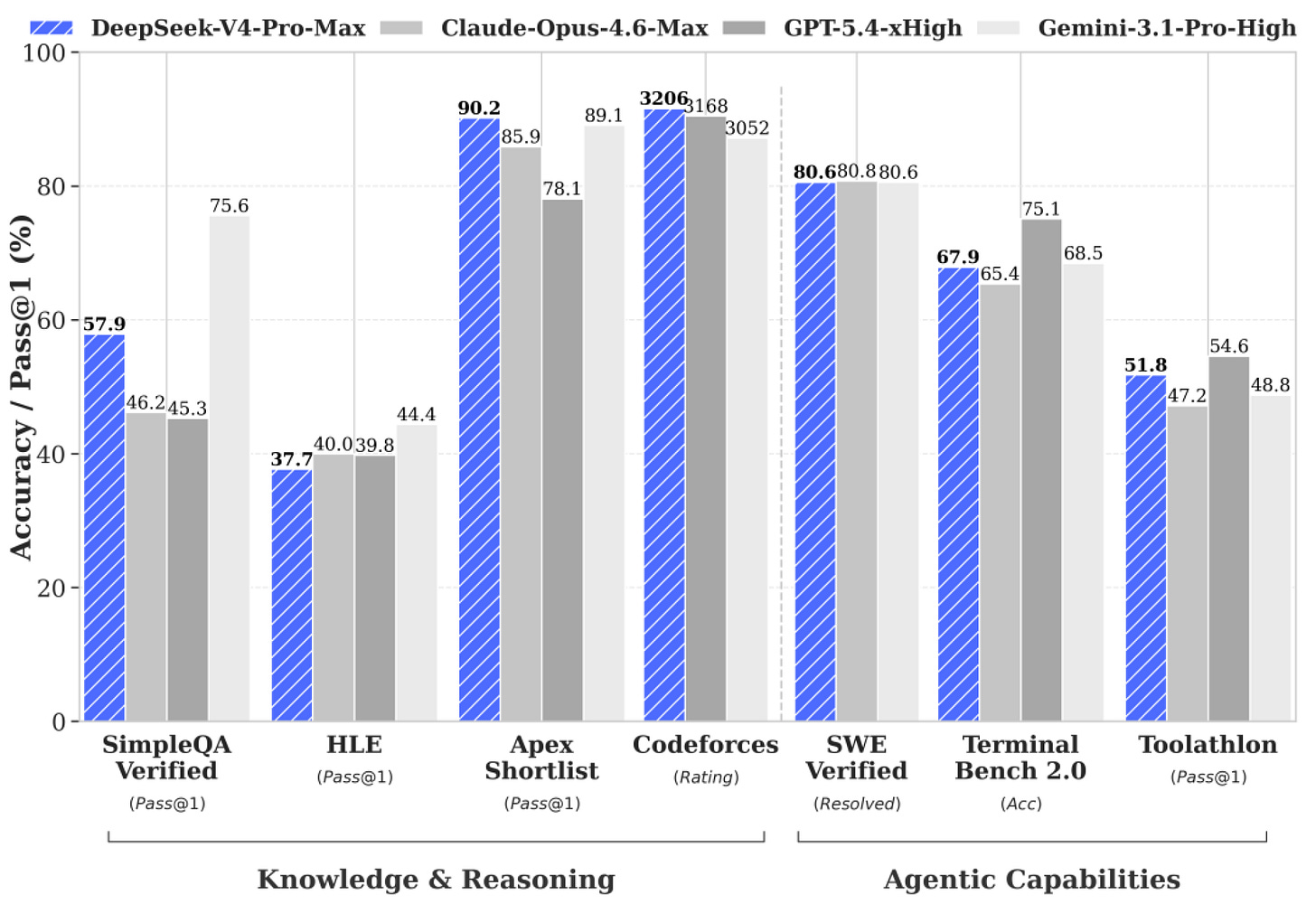
DeepSeek V4 benchmark performance comparison. Credit: DeepSeek OpenAI publishes five principles for its AGI push: Altman released a new operating framework covering democratization, empowerment, universal prosperity, resilience, and adaptability. Replaces the 2018 OpenAI Charter. Key shift: less emphasis on AGI specifically, drops the old language about helping rival labs if they got to safe AGI first, and gives OpenAI more room to restrict capabilities when “resilience matters more than user freedom.” The fifth principle (adaptability) is the most telling: the closer AI gets to AGI, the more access may become conditional. OpenAI is now talking like a cloud company, energy customer, and national security asset all at once. The paradox: wants broad access to AGI, but getting there requires massive centralized investment in compute, data centers, and energy that only a handful of companies can afford.
Meta signs deal for space-based solar power: Partnering with startup Overview Energy, which is developing a system to collect solar energy in orbit and beam it to ground facilities. Meta gets early access to up to 1 GW of capacity. Orbital demo expected 2028, commercial power delivery 2030. Meta is building gigawatt-scale data centers across the US and has already partnered with Vistra, Oklo, and TerraPower for nuclear power. AI’s energy appetite is pushing Big Tech into increasingly exotic power sources.
Who’s Hiring 💼
Alumni Ventures: Treasury Analyst - Manchester, NH; Senior Associate - Menlo Park, CA
a16z: GTM Strategy & Ops, Speedrun - Remote (US)
Planet A: Investment Associate - Berlin
500 Global: Analyst, Global Investment Team - Palo Alto, CA
Lightfield: Community Lead, AI Product Engineer, New Grad, AI Product Engineer, Machine Learning Engineer, Full Stack Engineer, Product & Systems, Founding Account Executive - San Francisco
Gradient: AI Researcher, Growth & BD, Head of BD, Gradient Ascent Program (Intern) - Remote (Anywhere)
Natter: Senior Frontend Engineer, Product Manager, Machine Learning Engineer, Senior Backend Engineer - Remote - GMT */-3hrs; Chief of Staff - New York; Founder Associate, Marketing Associate, EA, People & Culture Manager - London
Atlas: iOS Engineer, Software Engineer, Web Engineer - San Francisco
Pickle: Founding Frontend Engineer, Founding Platform Engineer - Hillsborough, CA
OffDeal: Full Stack Engineer, Investment Banker II - New York
Hamilton AI: Senior Product Builder, Staff Full Stack Engineer - San Francisco
Stainless: Business Operations, Recruiting Coordinator, Product Designer, Product Manager; Support Engineer - New York/Remote - Pacific Time; Software Engineer, Generalist, Product Marketing Manager - New York/San Francisco
Bland AI: Content Marketing Lead, Growth Coordinator, Customer Engineer, BDR, Head of Partnerships, Machine Learning Researcher, Audio, Machine Learning Researcher, Multimodal LLMs - San Francisco
Phonely: Founding Marketing Lead, Channel Partner Manager, Full Stack Engineer, Customer Success Representative, Enterprise Account Manager, DevOps Engineer - San Francisco
Sett: Senior Software Engineer, Partnership Growth Manager, Partnerships Operations, AI Creative Expert - Tel Aviv-Yafo
If you haven’t yet, please subscribe, like, leave a comment, and share it! It helps us continue to bring you the most interesting news + nuance in tech and business every week.
See you Wednesday, Ryan
Sponsorships: We are now accepting sponsors for Q2 ‘26. If you are interested in reaching my audience of founders, investors, and tech executives, send me an email at chief@whyjoin.xyz.
The founding team has seen this space up close. CEO Liz Dorman worked at Humane on AI orchestration before it got acquired by HP. CTO Alex Ollman built agentic frameworks at HP. CPO Megan Gole worked at Sutter Hill on the Jony Ive and Sam Altman io project before joining Era. So they’ve collectively been inside the companies that tried and struggled with AI hardware, and came away thinking the problem is the platform layer, not the devices.