
The Stack Is Breaking
New tools, new workflows, and why old systems can’t keep up
Hello hello!
Welcome to another edition of Why Join.
One of the more interesting patterns in technology is that progress rarely breaks things all at once. It accumulates quietly… until the systems built for a previous constraint start to fail under new conditions.
We’ve seen this before. Databases had to evolve when data exploded. Cloud computing emerged when fixed infrastructure couldn’t keep up with variable demand. And now, AI is creating a similar pressure, not just on models, but on the workflows built around them.
What’s notable is that the shift isn’t purely about capability. It’s about coordination… how work is generated, tracked, and executed when both humans and machines are contributing at a much higher pace.
This issue looks at a few places where that pressure is already visible, and how new systems are emerging to handle it.
A message from Guideless

Most product and ops teams document the same way. Someone records a Loom, drops it in Notion, and calls it done. Six months later the product has changed, the Loom is wrong, and new hires are still asking the same questions on Slack.
Guideless is a faster path. Install the Chrome extension, click through your workflow like you normally would, and it generates a narrated video guide on the other side automatically. AI writes the script, generates the voiceover, adds captions, and applies your branding. No recording setup, no editing, no script prep.
Teams use it for customer onboarding, sales demos, internal SOPs, and support docs. Guides are shareable via link or embeddable straight into your help center. When something changes in your product, you update the guide without starting over.
If your docs are always two releases behind, this closes that gap fast.
New users get 20% off for 3 months.1
Who Just Raised 💰
🇺🇸 Namespace

💵 Raised: $23M Series A, led by NEA. Susa Ventures and Burst Capital also in.
One-liner: High-performance compute environments for CI/CD in a world where AI agents are shipping code too.
Why it’s a fave: CI/CD pipelines were designed for a world where humans submitted a manageable number of pull requests. Now you’ve got agents and humans shipping code across multiple repos at much higher volume. Branches, builds, and test runs pile up, queues form, and every extra minute of build time gets multiplied across far more PRs. The pipeline as we know it, a static, sequential checklist built for human-paced development, isn’t designed for this.
Namespace replaces that with on-demand compute environments where both agents and humans can build, test, and deploy at their own speed. It drops into your existing setup (GitHub Actions, self-hosted runners, Kubernetes) without forcing you to rearchitect anything. Turbo Docker builds, remote caching, workflow analytics, built-in observability, and reproducible dev environments that spin up in seconds.
Hiring: Product Engineer, Developer Marketing Lead, Infrastructure Software Engineer - Switzerland; Germany; New York; San Francisco surroundings; United Kingdom
🇺🇸 PointOne

💵 Raised: $16M Series A, led by 8VC. Bessemer, General Catalyst, and YC also in. Total funding now $20M.
One-liner: AI-powered time tracking that turns law firm time data into real business intelligence.
Why it’s a fave: Law firms run on time data. Every pricing decision, staffing call, and profitability analysis flows from it. And the tools to capture that data have been, to quote the founders, “embarrassingly broken” for decades. Lawyers manually reconstruct their days at the end of the week, entries are vague or missing, and the downstream mess means pricing is a guess and profitability is a quarterly surprise.
PointOne automates time entry with AI so every hour is captured and the data is clean from the start. When that foundation works, everything else gets better. Pricing becomes defensible, staffing decisions are actually informed, and profitability becomes something you manage instead of something that happens to you.
They’ve expanded beyond time entry into bill review, outside counsel guidelines compliance, and pricing intelligence. Basically, treating timekeeping as the entry point to a much larger data strategy for firms.
Hiring: Customer Success Lead, Founding Forward Deployed Engineer, New Grad Software Engineer, GTM Engineer, Software Engineer, Growth Fellowship - NYC
🇺🇸 Littlebird

💵 Raised: $11M seed, led by Lotus Studio. Angels include Lenny Rachitsky, Scott Belsky, Gokul Rajaram, and DocSend co-founder Russ Heddleston.
One-liner: Desktop AI that reads your screen all day and builds a deep understanding of your work and life.
Why it’s a fave: Littlebird is built around what it calls “quiet computing.” It sits in the background, reads the text on your screen across apps, and builds a running picture of who matters to you, what you’re working on, and what you care about this week and this year.
You’ve seen this idea before. Rewind (now sold to Meta) and Microsoft Recall both tried to capture everything on your screen. The problem: they stored screenshots, which is data-heavy, kind of creepy, and the search experience wasn’t great. Littlebird takes a different approach. It “reads” your screen but only stores text, no visual data. Way lighter, way less invasive.
It runs quietly in the background, captures context from whatever you’re doing, and only shows up when you ask it something. You can customize which apps it ignores (password managers and sensitive fields are excluded automatically). Connect Gmail, calendar, etc., and it builds a live picture of your work life.
There’s also a Granola-style meeting notetaker built in that uses system audio, plus a “Prep for meeting” feature that pulls context from past meetings, emails, and company history. It also has “Routines,” basically recurring prompts like daily briefings or weekly summaries.
Hiring: Product Analyst, Brand (Visual) Designer, GTM Associate - Growth Marketing, Swift Engineer, Applied AI Engineer - Agent Intelligence & Retrieval - Remote
Open Tabs (stuff we’re reading) 📖
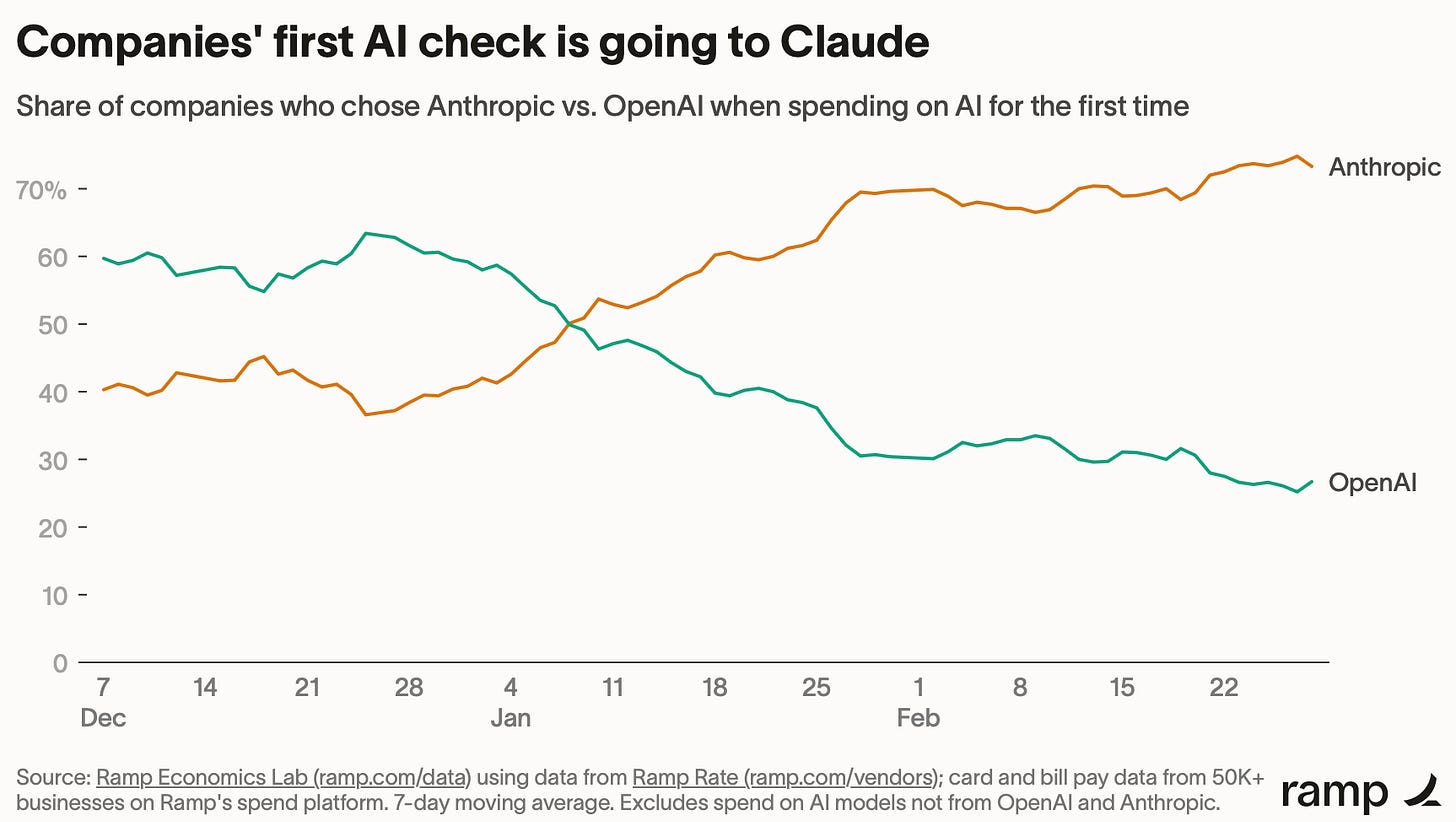
OpenAI plans to nearly double workforce to 8,000 by end of 2026: Hiring ~12 people/day, just leased 1M+ sq ft in SF. Big reason: Anthropic is eating their lunch with business customers. Ramp data shows first-time AI buyers choosing Anthropic at 3x the rate of OpenAI, a full reversal from last year. (OpenAI called the data "insane.") Altman issued a "code red" back in December, and apps chief Fidji Simo told staff to ditch "side quests" and focus on Codex, enterprise, and turning ChatGPT into a productivity tool. OpenAI expects half its revenue from business customers by year-end, up from 40%.
ChatGPT ads pilot and nobody can prove they work: OpenAI got WPP, Omnicom, Dentsu into an alpha test but early numbers look weak. Per The Information, one brand saw ~0.91% CTR, nearly 7x below Google search benchmarks. Another spent just 3% of a $250K budget after weeks. OpenAI’s own Ad Manager is buggy, advertisers can’t properly see their data. There’s also a structural issue. Ads only reach free and Go users, paying subs never see them. Altman used to call ads a “last resort.” Pilot ends this month and so far no clear ROI. Despite that, OpenAI is doubling down. Hired Meta ads veteran David Dugan to lead global ads, building out its ad stack, and asking brands for ~$200K minimum commitments.
Tesla, SpaceX announce $25B “Terafab” chip factory: Musk unveiled a joint venture between Tesla, SpaceX, and xAI to build what he calls the biggest semiconductor fab ever in Austin, TX. Targeting 2nm chips, 100K wafer starts/month scaling to 1M (that’s ~70% of TSMC’s entire global output, from a single building, by companies that have never made a chip). 80% of compute would go to orbital AI satellites, 20% ground-based. Tesla’s CFO said the $20-25B cost isn’t even in their 2026 capex plan yet. For context: TSMC spent $165B and decades building six fabs in Arizona. Tesla has zero chip fab experience. As Electrek put it: “This is Battery Day on steroids. And if you’ve been following how that turned out, you should be very skeptical.”
SoftBank might go past its own leverage limit to push harder on AI: CFO said the 25% LTV cap can be exceeded. That cap was supposed to be their safety line. Now it’s flexible, so expect more borrowing. Reason is simple. They’re spending big on AI. $100B Stargate with OpenAI and Oracle. That kind of spend needs cash. Either sell assets or take on debt. Looks like debt. Arm is the swing factor. It’s a big part of their assets and the stock has been moving a lot. If it drops, leverage goes up even without new borrowing. This matters because once you bend a “hard limit,” people stop trusting it. SoftBank already takes big swings. More debt on top makes things more fragile. Main risk is if Arm falls while debt is high. That’s how things got messy in 2020.
Bipartisan bill targets prediction markets like Kalshi, Polymarket: US senators want to ban sports betting on these platforms, saying it’s basically gambling under a different label. Would not touch FanDuel or DraftKings since those are state-regulated. Prediction markets sit under federal rules (CFTC), so they’ve been able to operate nationwide. Lawmakers are saying that’s a loophole. Kalshi alone saw ~$1B in Super Bowl trades, up ~2700% YoY. Pushback is predictable. Kalshi says this is casino lobbying trying to kill competition and will just push users offshore. There’s also real concern around addiction. Data shows gambling-related searches jumped ~61% after online betting expanded. Platforms are already under pressure. Kalshi is banned in Nevada, facing issues in Arizona, and recently cracked down on insider-style betting. Polymarket also tightened rules around using non-public info.
OnlyFans billionaire Leonid Radvinsky dies at 43: The owner who turned OnlyFans into a massive porn platform passed away after cancer. He bought the company in 2018 and scaled it into a cash machine, reportedly making ~$1.9M a day at peak. OnlyFans exploded during Covid. Users went from ~13M in 2019 to ~188M by 2021. Revenue hit ~$1.4B in 2024, with ~$7.2B spent on the platform. Radvinsky’s net worth reached ~$4.7B. His background was controversial. Started young with spammy porn sites that promised illegal content but mainly monetized clicks. Later built MyFreeCams before acquiring OnlyFans. He kept a low profile. Rarely gave interviews and stayed out of the spotlight despite running one of the biggest creator platforms online.
Anthropic pushes deeper into AI agents with Claude controlling your computer: New feature lets you send a task from your phone and Claude completes it on your PC. It can open apps, browse, edit files, even send emails. This is part of the agent race. After OpenClaw went viral, everyone is trying to build “do things for you” AI, not just chat. Nvidia called OpenClaw the next ChatGPT. OpenAI already hired its creator. Use case is simple. Ask Claude to export a deck, attach it, send it. It just does it. Still early though. Anthropic says it can make mistakes and will ask permission before accessing apps.
Delve “fake compliance” scandal getting worse and investors are backing off: YC-backed startup accused of fabricating audit evidence for customers. Claims include fake board meetings, fake tests, and reports that never actually happened. This is not small. Delve sells compliance for things like SOC 2, HIPAA, GDPR. If that’s fake, customers could be exposed to real legal risk. Allegations say the whole system was inverted. Delve generates the evidence, then audits get “rubber stamped” instead of independently verified. Fallout is already showing. Insight Partners pulled its investment post. Delve also reportedly paused demos, which is basically growth on hold. Delve denies it. Says it’s just automation + templates, and real audits are done by third parties. Bigger issue here is trust. Compliance is not a nice-to-have product. It’s the product. If that breaks, the whole thing collapses.
Who’s Hiring 💼
BlueFlag Security: Product Manager, Software Engineer - Hyderabad, India; Data Scientist - SF Bay Area
Cape: Operations Analyst, Enterprise, Full Stack Software Engineer - New York/ Software Engineer - New York; Washington
RunSybil: Account Executive, Software Engineer - NYC/ Customer Success Manager, Machine Learning Engineer - NYC; SF
Gimlet Labs: Founding Marketer, Member of Technical Staff (Intern), Member of Technical Staff - AI Research (Intern) - SF
Dash0: Head of Design, Senior Marketing Operations Manager, RevOps Manager, Digital Marketing Manager - EMEA - Remote/ Talent Acquisition (Intern) - Germany - Remote/ Commercial SDR - US, SDR Manager - US - New York/ Partnerships Manager - Amsterdam; London
Parallel: Account Executive, Operations Associate - Paris
Edra: AI Engineer, Software Engineer - Full Stack - London/ AI Engineer, Product Designer, Software Engineer - Full Stack, Office Manager & Executive Assistant - New York
Corridor: AI Lead, AI Engineer, Software Engineer, Founding Technical Recruiter, Marketing Manager, Community Manager - SF
redalpine: Visiting Analyst (early stage investments) - Zug; Berlin; London
M13: Investment Summer Associate - AI Tooling - SF
defy.vc: Analyst - Remote
If you haven’t yet, please subscribe, like, leave a comment, and share it! It helps us continue to bring you the most interesting news + nuance in tech and business every week.
See you Thursday, Ryan
Sponsorships: We are now accepting sponsors for Q2 ‘26. If you are interested in reaching my audience of founders, investors, and tech executives, send me an email at chief@whyjoin.xyz.
This issue contains sponsored content.