
AI for Emergencies, Algorithms for Atoms, Simulations for Strategy
Anthropic raises at a $183B valuation, Klarna eyes the NYSE, and eight VC firms unite to back India’s deep tech wave. Plus: startup jobs, product launches, and what’s happening across AI.
Hey—
Welcome to this week’s Why Join.
Skipping the small talk. Let’s get into it.
Sponsored by The Hustle

200+ AI Side Hustles to Start Right Now
From prompt engineering to AI apps, there are countless ways to profit from AI now. Our guide reveals 200+ actionable AI business models, from no-code solutions to advanced applications.
Learn how people are earning $500-$10,000 monthly with tools that didn't exist last year. Sign up for The Hustle to get the guide and daily insights.
P.S. Want to sponsor this newsletter? Simply reply to this email or book one here.
Latest in Startups
🇬🇧 Attio

Funding - Series B, $52M; Investors - GV (Google Ventures) (lead), Redpoint Ventures, Balderton Capital, Point Nine, 01A
Attio is a programmable, AI-native CRM built from scratch. Not another layer on top of Salesforce. A full re-architecture of how go-to-market teams manage customers, data, and workflows.
The B2B CRM market is massive and growing fast. Salesforce, Zoho, and HubSpot lead it, and it’s projected to hit $80 to $112 billion in 2025. But the software layer hasn’t evolved. Most CRMs were built 20+ years ago. Sales cultures formed around them, but the tools stayed frozen. Manual input. Fixed stages. Batch reports. Meanwhile, customers changed. GTM teams now run async cycles, ship tests weekly, and can’t wait to see what’s working.
Attio treats CRM less like a system of record and more like a living system. Data updates in real time. Logic is programmable. AI isn’t layered on later—it’s how the thing works from day one.
What that looks like:
Ingests and enriches customer data automatically, no setup time
Triggers actions on live events, not batched workflows
Programmable blocks let teams build apps inside the CRM
Minimal interface with flexible views, not endless dropdowns
Agents that act on data, not just surface it
Hiring: Senior Product Manager (Growth), Creator Partnerships Lead, Senior Product Engineer (Frontend) - London/Remote; Sales Development Representative - New York/San Francisco
🇺🇸 Aurelian
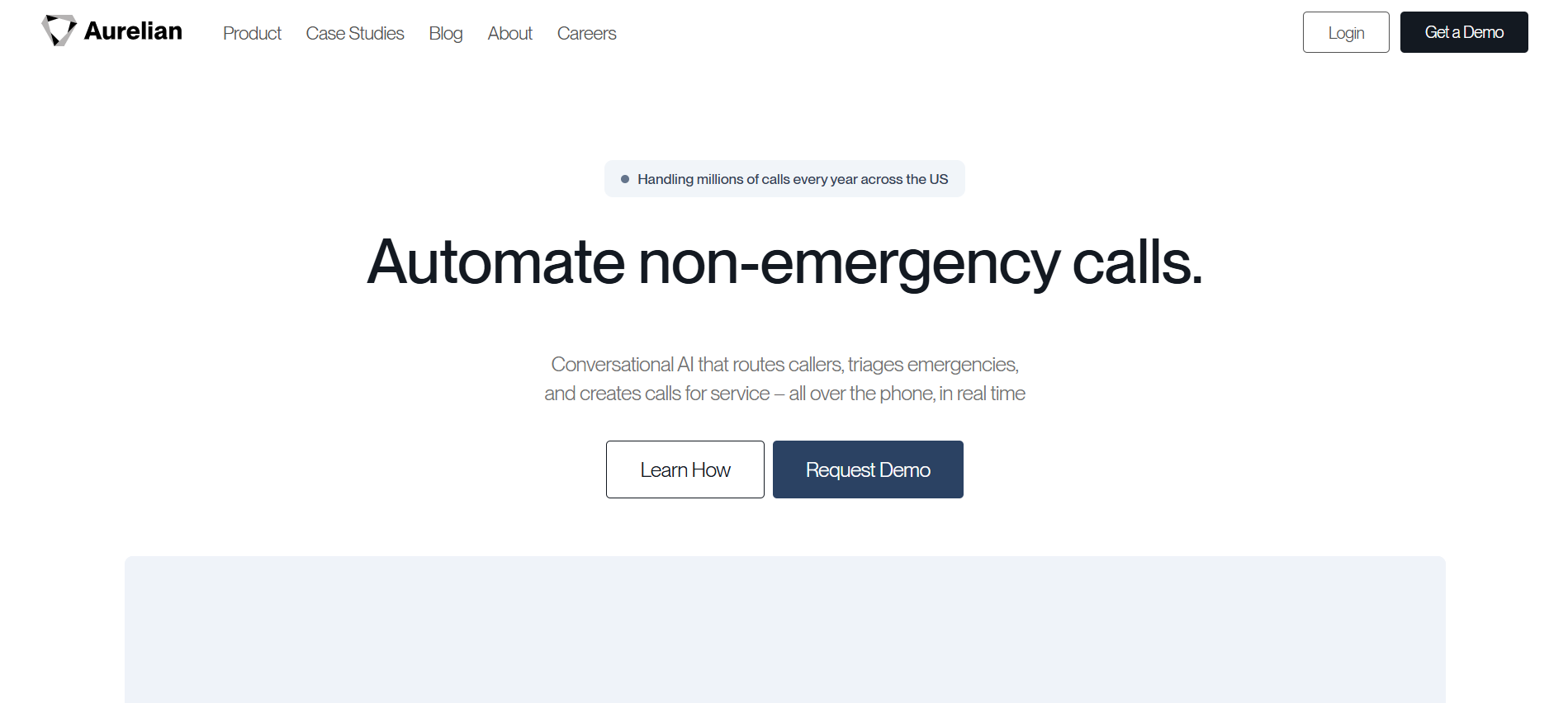
Funding - Series A, $14M; Investors - NEA (lead), Y Combinator, FUSE, Liquid 2, Palm Drive Capital
AI voice assistant that handles non-emergency 911 calls. Deployed in over a dozen dispatch centers across the U.S., it automates the 60–80% of inbound volume that doesn’t require lights and sirens. Think noise complaints, parking violations, stolen wallets.
Most Americans don’t realize non-emergency calls often go to the same operators handling actual emergencies. That’s a problem. The job already ranks among the top 10 for burnout and turnover. One in four seats go unfilled. In cities like San Francisco, average wait times for non-emergency lines routinely exceed 60 minutes. Not a fluke. They’ve missed their target 105 out of the last 108 months.
But 911 isn’t an industry where you can ship a beta and hope it works. Public safety requires 24/7 uptime, no hallucinations, no missed handoffs. Aurelian ships with support, configures to each dispatch center’s legacy stack, and avoids forcing a full rip and replace.
Aurelian’s AI agent answers those calls instantly. It handles intake, validates location, files into the CAD system, and escalates actual emergencies to a human dispatcher. The system doesn’t replace humans. It fills seats cities can’t staff, with budget often coming from labor lines rather than new software spend.
Hiring: Chief of Staff, Head of Sales, Platform Engineer, Full Stack Software Engineer, Backend Software Engineer, Head of Talent - Seattle
🇬🇧 Phasecraft
Funding - Series B, $34M; Investors - Plural (co-lead), Playground Global (co-lead), Novo Holdings, AlbionVC, Latitude, Parkwalk Advisors
Most of the quantum world has been focused on hardware. The assumption was once we build the machines, the use cases will follow. But quantum hardware hasn’t improved fast enough to hit fault tolerance or error correction. Phasecraft is working the other angle. They’re designing algorithms that make near-term quantum systems useful now.
Their approach is hybrid. Use quantum only where it gives leverage. One example: they’ve developed a faster way to run a key step in density functional theory, a tool chemists use to model molecules and atoms. Early targets include batteries and drug compounds. Even mild speedups could unlock real value, especially in climate science and pharma where trial-and-error bottlenecks are slow and expensive.
A lot of quantum software still assumes future-scale machines. Phasecraft doesn’t. Their algorithms run now, on NISQ-era hardware from IBM, Google, and Quantinuum. The code is tested against real physics problems. Some of their simulations, like materials modeling or grid optimization, are already being scoped for commercial use in the next 12 to 24 months.
The bar is still high. There’s no agreed definition of quantum advantage.
Hiring: Chief of Staff, Quantum Algorithms Engineer - London/Bristol; Quantum Algorithms Scientist - Washington; Visiting Fellow - London/Bristol/Washington
🇬🇧 Artificial Societies

Funding - Seed, $5.3M; Investors - Point72 Ventures (lead), Kindred Capital, Y Combinator, Pioneer Fund
Artificial Societies uses AI to simulate large groups of people and how they interact. Companies like Anthropic and 11x are using it to predict how marketing and content will perform in a simulation of their target customers, before launching in the real world.
Traditional market research fails to account for influence. Most tools treat people like static, individual units. But we don’t decide in vacuums. We’re networked animals. Artificial Societies simulates how groups think, shift, and react, using AI trained to behave like actual humans in context.
Their first product, Reach, lets you simulate your actual LinkedIn audience. You plug in a draft post, and it predicts how people will respond with 83 percent accuracy. Not vibes. Not generic sentiment. Simulations grounded in past behavior and social graph dynamics.
Use case expansion: investor sims, growth tests, brand building

The $2 Trillion Asset Class You're Missing
While retail investors chase volatile tech stocks, institutions like BlackRock and KKR are quietly allocating billions to private credit—a market that's grown 19x since 2006 and now approaches $2 trillion globally.
Why? Private credit offers what traditional portfolios increasingly lack: consistent yield potential (Percent's marketplace delivered 14.9% average net returns in 2024), lower correlation to public markets, and shorter investment horizons averaging just 9 months.
With Percent, accredited investors can now access the same institutional-quality deals that were once exclusive to the ultra-wealthy. Start with as little as $500 and get up to $500 on your first investment. Invest like the smart money.
Access Institutional-Grade Private Credit (Sponsored)
Top News
Microsoft debuts in-house AI models (finally): Microsoft AI just launched MAI-Voice-1 (speech) and MAI-1-preview (text), its first homegrown models. Voice-1 powers Copilot’s news recaps and explainer podcasts, while MAI-1-preview (trained on 15k H100s) is now live in testing and built for everyday queries. It will slot into Copilot alongside OpenAI’s models, adding a new twist to their tangled partnership.
Revolut kicks off $75B valuation share sale: Employees can now sell up to 20% of their shares at $1,381.06 each in a new secondary offering, valuing the fintech at $75B, up from $45B last year. That puts Revolut above Barclays (by private market standards) and cements it as one of the world’s most valuable fintechs. The firm now boasts 60M+ customers, $4B in revenue, and is eyeing a U.S. acquisition to secure a banking license.
Anthropic raises $13B at $183B valuation: Claude’s parent company just closed a massive Series F led by ICONIQ, pushing its valuation to $183B. Revenue has rocketed from $1B to $5B run-rate in 8 months, with over 300K business customers and 7× growth in large accounts. Claude Code alone is now at $500M run-rate just months after launch. Anthropic says the new funding will go toward scaling infra, global expansion, and safety research.
Accel, Blume, Premji & others form $1B India deep tech alliance: Eight top VCs and PE firms have pledged $1B+ over the next decade to back India-domiciled deep tech startups, forming a rare formal coalition. Dubbed the India Deep Tech Investment Alliance, it’s designed to channel early-stage capital into AI, space, robotics, semis, biotech, and climate, aligning with India’s new $11B RDI scheme. Members include Accel, Blume, Celesta, Premji Invest, and more.
Klarna revives IPO at up to $14B valuation: The Swedish BNPL giant plans to list on the NYSE under “KLAR,” aiming to raise $1.27B by selling ~34.3M shares at $35–$37 each. Klarna hit a $45B peak in 2021 before falling to $6.5B, and is now climbing back amid 54% YoY revenue growth ($823M in Q2). Net loss narrowed to $53M. Goldman, JPM, and Morgan Stanley are leading the deal.
Lovable receives funding offers at $4B valuation weeks after $200M round: The Stockholm-based AI “vibe coding” startup is getting unsolicited offers valuing it at over $4B, just weeks after raising $200M at a $1.8B valuation (Accel led, after a $15M Creandum round in Feb). Not raising (yet), but already doing $100M+ ARR with 10M+ projects built.
Framer hits $2B valuation with $100M Series D: The Amsterdam-based no-code site builder just raised $100M (Meritech, Atomico) at a $2B valuation. Framer’s now break-even, at $50M ARR, with eyes on $100M next year. Enterprise is driving growth—40% of YC’s latest batch uses it, along with Miro, Perplexity, and Scale AI.
Anthropic now wants your chats for training: Claude users must opt out by Sept 28 or have their conversations (and code) stored for up to 5 years and used to train future models. The change applies to all consumer plans (Free, Pro, Max, Code), but not business or API users. Like others in the AI race, Anthropic needs real user data, and the default toggle is set to “on.”
Nvidia rakes in $41B—but from just a few buyers: In Q2, Nvidia pulled $41.3B from its Compute & Networking segment (up 56% YoY), with three unnamed customers making up 53% of that total. “Customer A” alone accounted for 23% (~$9.5B)—likely Meta or OpenAI, both racing to build multi-gigawatt AI data centers. Meanwhile, xAI is aiming for 50M H100-equivalent units in five years.
Whether you’re dealing with grief, want to improve your coping strategies, or you’re just feeling down—therapy is for you. BetterHelp makes starting therapy easy, and it’s 100% online.
Here’s how it works:
Take our questionnaire and get matched with a therapist.
Schedule a time to meet and communicate on your terms.
Reach out to your therapist anytime, from anywhere.
Get Started with 25% off Your First Month (Sponsored)
Open Roles
Polychain: Venture Research Analyst - San Francisco
Temasek: Associate, Investment - New York
Coinbase: Coinbase Ventures Associate - Remote (US)
Stripe: Private Equity Lead, EMEA - London
Roofline: Founders Associate - Cologne
Gradient Labs: AI Product Specialist, Product Designer, AI Engineer - London; Business Development Representative - New York
Julius: Senior Software Engineer - Frontend, Software Engineer - Backend, Product Designer, Growth Marketing Manager - San Francisco
E2B: Head of Marketing & Growth, Platform Engineer - San Francisco; AI Engineer - Prague/San Francisco
Lumana: Demand Generation Manager, Corporate Account Executive - Remote (US)
retab: Intern - Software Engineering, Intern - ML Engineering, Fullstack Engineer - Paris/Remote
Keye: Founding Private Equity Strategist, Senior Software Engineer - New York
Langdock: AI Associate, Product Engineer (Fullstack) - Berlin
Stacks: Business Development Representative, Product Engineer (Fullstack) - Amsterdam; Customer Success Manager, Senior Account Executive - London
That’s all for now. If you liked what you read, consider adding us to your address book or just hit reply—it helps with deliverability. If not, you can unsubscribe below.
See you Thursday,
Chief